

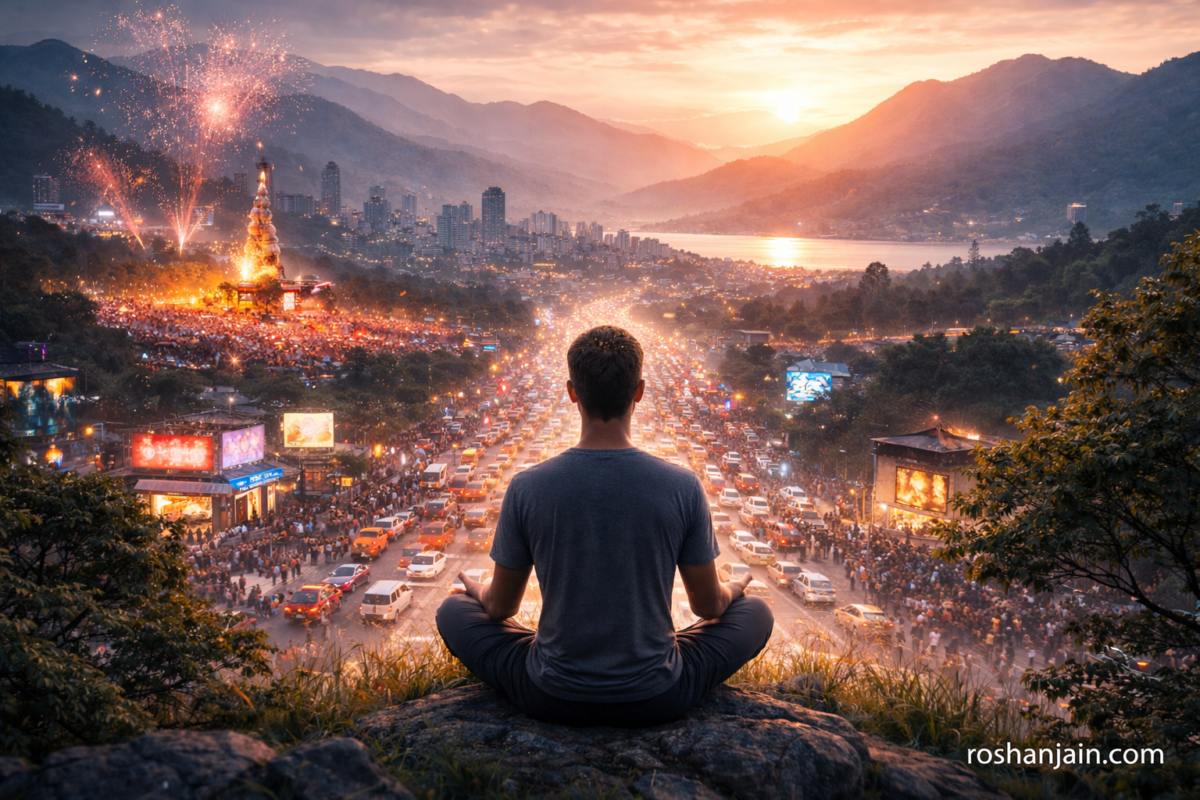
In an increasingly noisy and chaotic world, it has become more important now than ever to take note — and to consciously minimise both.
Just take a look around. Noise is everywhere. And we spare no effort in creating more of it.
Reels are blaring in public spaces without regard for others.
Relentless honking on the streets.
Noise in the name of celebration — weddings, birthdays, festivals.
Noise in the name of devotion — loudspeakers at temples, mosques, and street processions.
We inject noise into quiet environments, and then complain that we cannot find peace.
So we escape to serene mountains or beachside resorts, paying an arm and a leg in the hope of silence. And once there, many recreate the same noise again, calling it a party.
Equally, we create chaos and then complain about living in it.
We try to get away from it, only to reproduce the same chaos elsewhere.
We create chaos outside, go home seeking peace and order and then bring it back into the home.
We create noise outside and then make the peaceful home noisy too.
Why Modern Life Is Becoming Increasingly Noisy and Chaotic
Noise today is not accidental. It is constant, layered, and socially normalised.
Chaos is no longer the exception; it has become the background.
Urban living, overcrowding, poor civic discipline, overstimulation through screens, and a collective loss of patience have created an environment where the nervous system rarely gets a break.
And the mind pays the price.
How Much Noise Is Too Much for Mental Health?
To understand the impact of noise pollution on mental health, let’s look at the numbers.
-
Healthy, comfortable sound levels: 30–40 decibels (dB) — similar to a quiet room
-
WHO recommended limits:
-
55 dB during the day
-
40 dB at night
-
Now compare that with everyday urban reality:
-
Busy city traffic: 70–85 dB
-
Continuous honking at intersections: 90 dB or more
-
Wedding bands, DJs, loudspeakers: 95–110 dB
-
Firecrackers and amplified processions: 120 dB and above
At these levels, the brain remains in a state of heightened alert. Stress hormones rise. Sleep becomes fragmented. Irritability increases. Focus declines. Over time, excessive noise is not just annoying — it becomes a chronic mental health stressor.
The Psychological Impact of Noise and Chaos
Noise overwhelms the senses.
Chaos overwhelms the mind.
Together, they push the nervous system into survival mode.
Chronic exposure to noise and disorder has been linked to:
-
Increased anxiety and irritability
-
Poor sleep quality
-
Reduced concentration and productivity
-
Emotional exhaustion and burnout
The mind never truly rests when the environment never quietens.
Stampedes, Crowds, and the Cost of Disorder
Chaos has consequences beyond discomfort.
Across the world, data consistently shows that most stampede-related injuries and deaths occur not due to natural disasters, but due to poor crowd management, panic, and lack of coordination — often during religious gatherings, celebrations, or poorly regulated events.
Stampedes are not caused solely by numbers.
They are caused by disorder, fear, and the absence of calm leadership.
Chaos amplifies fear. And fear spreads faster than sound.
The Uncomfortable Truth About Noise and Chaos
We are not just victims of noise and chaos.
We are also contributors.
We add to the noise.
We add to the disorder.
And then we search desperately for peace elsewhere.
Peace cannot be outsourced.
How to Reduce Noise and Chaos in Daily Life
Peace does not begin in the mountains or by the sea.
It begins in the nervous system.
Small, conscious choices matter:
-
Lower the volume — literally and emotionally
-
Pause before honking, before amplifying sound, before adding noise to shared spaces
-
Choose quieter, more meaningful celebrations
-
Create silence at home — no background TV, no constant scrolling, no noise as default
-
Bring order into daily life through simple routines and realistic boundaries
Externally, reduce stimulation.
Internally, reduce reactivity.
Finding Peace Without Escaping the World
Slow the mind. Reduce mental clutter. Allow pauses instead of constant engagement.
In the pursuit — or hope — of peace, we do not need to escape the world.
We need to stop recreating its noise and chaos wherever we go.
Because a quieter world begins with quieter minds.
© Dr Roshan Jain 10 January 2026
____________
Dr Roshan Jain is a psychiatrist, educator, and mental health advocate committed to mindful, ethical, and empowering approaches to emotional well-being. He shares insights across multiple platforms to make mental health knowledge accessible and practical for all:
- 🎙️ Podcast: Mind Matters; 📸 Instagram: @_mindsense; ✍️ MindBlog: roshanjain.com; 📺 YouTube: Mindism