

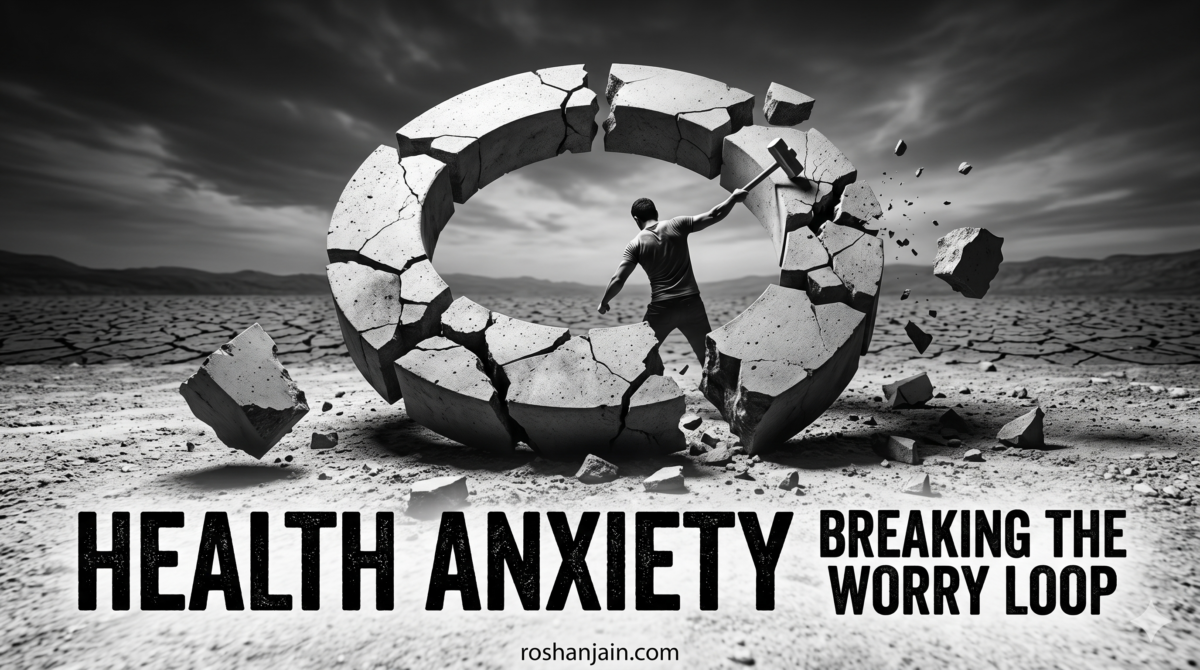
“The greatest burden is not the illness itself, but the fear of what it might become.”
Health anxiety is far more common than many of us realise. It is that persistent, nagging worry about your health that lingers even after a normal medical evaluation. What begins as a harmless bodily sensation can quickly spiral into a cycle of fear, checking, and repeated reassurance-seeking.
This blog explores what health anxiety really is, why it persists, and how you can begin to break the cycle.
The Anatomy of Health Anxiety
Health anxiety is the excessive worry about having or developing a serious illness. The core issue isn’t usually the physical sensation itself, but our interpretation of that sensation.
We often misinterpret normal bodily functions—like a mild headache, a twitch, or an increased heart rate—as definitive signs of a serious condition. Common signs include:
- Hyper-vigilance: Constant monitoring of bodily sensations.
- The “Dr. Google” Trap: Frequent, urgent searches about symptoms.
- The Reassurance Loop: Repeated doctor visits despite being told you are healthy.
- The “Relief Gap”: Temporary calm followed by a quick return of anxiety.
The Health Anxiety Loop
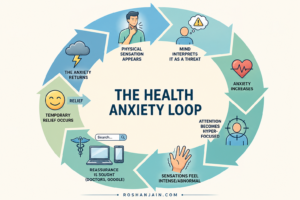
As illustrated in the above image, health anxiety operates in a predictable, self-reinforcing cycle:
- Trigger: A physical sensation appears.
- Threat Appraisal: The mind interprets it as a danger.
- Escalation: Anxiety increases.
- Hyper-focus: Attention becomes locked on the body.
- Amplification: Sensations feel more intense or “abnormal” because you are focused on them.
- Action: Reassurance is sought through tests, doctors, or the internet.
- Temporary Calm: Relief occurs.
- The Return: The anxiety returns with a new sensation or doubt.
This loop makes the worry feel more real and urgent every time it completes a full circle.
Why Reassurance Isn’t the Cure
It seems logical that medical reassurance should end the anxiety. However, seeking it repeatedly often has the opposite effect. Each time you seek external validation, your brain learns two unhelpful lessons:
- “I cannot trust my body without checking.”
- “Relief can only come from external validation.”
This creates a dependency. Over time, the relief becomes shorter-lived, and the anxiety returns faster. While medical consultations are necessary, frequent “reassurance-seeking” unintentionally maintains the very cycle of anxiety you are trying to escape.
“Peace that depends on constant reassurance is never truly stable.”
The Role of Personality and Stress
Understanding why this happens is the first step toward change. Certain personality traits and life circumstances can increase your vulnerability to health anxiety, such as:
- High Sensitivity: A naturally high awareness of bodily sensations.
- A Need for Certainty: Difficulty sitting with the “unknowns” of health.
- Stressful Life Events: High periods of general stress can lower your “anxiety threshold.”
Steps Toward Recovery
Breaking the loop is a gradual process of retraining your brain to trust your body again. Start with these small, manageable shifts:
- Delay the Search: When you feel the urge to Google a symptom, wait 15 minutes. Gradually increase this delay over time.
- Balance Your Thoughts: For every “catastrophic” interpretation (e.g., “This headache is a tumour”), practice writing down a balanced alternative (e.g., “This headache is likely from dehydration or stress”).
- Anchor in the Present: Use mindfulness to observe sensations without judgment. Note them as “mental events” rather than urgent facts.
The goal isn’t to eliminate all worry, but to learn to live confidently amid life’s natural uncertainties.
Recommended Reading
If you would like to dive deeper into managing these patterns, the following books are excellent resources:
- Overcoming Health Anxiety by Martin Antony and Catherine Pittman: A structured guide using Cognitive Behavioural Therapy (CBT) to challenge the beliefs fueling your worry.
- The Complete Guide to Overcoming Health Anxiety by Josh Spitalnick and Michael Stier: An expert-led guide that uses a compassionate and accessible tone to explain how health anxiety works.
- The Anxiety and Worry Workbook by David A. Clark and Aaron T. Beck: A “gold standard” resource for deconstructing the cognitive loops and threat interpretations that drive general anxiety.
© Dr Roshan Jain 2 May 2026
____
Dr Roshan Jain is a psychiatrist, educator, and mental health advocate committed to mindful, ethical, and empowering approaches to emotional well-being. He shares insights across multiple platforms to make mental health knowledge accessible and practical for all:
- 🎙️ Podcast: Mind Matters; 📸 Instagram: @_mindsense; ✍️ MindBlog: roshanjain.com; 📺 YouTube: Mindism